Monday, July 25, 2016

Life Lessons from Comic-con: Kevin Smith, Ron Moore, and J. Michael Stravinsky


I just got back from San Diego Comic-Con (SDCC) and it was as usual, a madhouse.  Some 200,000 people went through the convention center, and there were great costumes and panels.  While I could tell you about the various announcements (the new Wonder Woman trailer for example), those have been covered by many other sources.

Comic-con is actually a pretty inspiring place for writers and creative types, who often start as “fans” and end up giants in the field.  In addition to the big giant panels (Game of Thrones, Star Trek, Star Wars, Walking Dead) there are actually a lot of smaller panels that offer tips for those looking to break into the industry and to create their own art.

I thought I’d write about lessons from 3 well-known writers who spoke at Comic-Con whose talks you may not have heard about on the latest geek newssite:
  • Kevin Smith, who usually has a huge session at Hall H on Saturday night, is of course the writer/director of Mall Rats and Clerks in the 90s, and just launched a show on AMC called Geeking Out. 
  • J. Michael Stracinsky is the creator of Babylon 5 and the more recent Sense8, and a well known writer in Hollywood.  
  • Ron Moore, recently show runner of Outlander and Battlestare Galactica, started his career working on Star Trek: The Next Generation.


While I could write entire blog posts about each of these guys and what they said at Comic-Con, I thought I’d share one little inspiring tidbit from each talk:

J. Michael Stracinsky:  At the end of his talk, JMS told us that he was once just like those of us in the audience, sitting at Comic-con looking up to the writers/creators on the stage.  He did this to encourage those of us in the audience to “take the leap” and express ourselves creatively, and see if we can turn it into a career.  

He then told us the story of one of his friends who worked for the state of California until she was 53 years old.  She told JMS that she felt like there was nothing of her in the work she was doing – there was no creativity, and she wanted to do something that expressed her personality more, but felt like it was too late.  JMS asked her what she was passionate about – and she said she liked “pets”.  She was also into “photography”.  He encouraged her to combine these interests and to do “pet photography”.  Her objection was that while that would be a good "hobby",  it would take years to establish herself to be able to make a living at something like, this – it might even take three years, and then she’d be 56 before she was really doing what she loved as a career.  At this point, he paused and told us he asked her this question: “And how old will you be in in 3 years if you don’t pursue this passion project?”

“That’s right, you’ll be 56 years old.”  He told us this story, he said, to remind us first of all that it’s never too late to get started, but also to remind us that time is passing and that we should get started on those ideas and stop wasting time, start doing the things that we love now.
.
Ron Moore:  Ron was on a panel with other writers of Star Trek.  Of course, he spent many years working on Star Trek: The Next Generation and then various other Star Trek properties before becoming a show runner of his own.  He tells the story of how after he moved to LA, he was struggling as a writer.  He started dating a girl that worked on the set of the new Star Trek.  She was able to get him a tour of the set.  He was so excited that he wrote up a spec script for ST:TNG and took it with him.  At the end of the tour, he pulled out the script and asked the guy who was giving the tour if they could get the spec script to someone that could take a look. The tour guide ended up being Gene Roddenberry’s assistant, and took the script to the show producers, who liked it enough to hire him as a writer on the show.  It goes to show you, you never know what coincidences or circumstances will lead you to get a break in front of the right person.


Kevin Smith: Kevin always gives a great talk at the end of Comic-Con, usually with a few unexpected stories about Ben Affleck and/or JJ Abrams (whose Star Wars Panel  was just before Smith’s last year).  Kevin said a lot, but here are a few random inspiring thoughts. You can make a TV show but getting it on a network may be tough; you can make a movie, but getting it into theaters may be tough.  Do a podcast and there are no gatekeepers, you can send it in to iTunes and there it is, and he encouraged everyone to start their own podcasts, just start recording yourself and others talking about stuff that you care about.  He also said that there was a time when Star Wars wasn’t cool (I remember this time) and no one talked about it.  Grown men were OK talking about sports and stats, but not about Star Wars and Comic-books.  Since he had no one else to talk to about Star Wars, he put scenes in his movies where the characters were sitting around talking about Star Wars. This inadvertently led to many opportunities for him – but the key was he was just putting down what he wanted to talk about.

How many times, he asked, have you sat there watching something on TV or elsewhere and thought, I’m just as smart as those guys, and could do this as good as they’re doing it? He used to think the same thing.  He told us the story of how he told his sister, when he was 21 years old, that he told his sister that he was going to be a film-maker.  She told him “OK, then be a film-maker”.  He repated that he “was going to become” a filmmaker, but she insisted that he just start “being a film-maker”.  He started following the advice and started to think about of himself as a film-maker who just hadn’t made a full feature film yet.  He adopted the mindset of a being a film-maker and started making films about stuff he knew and he was passionate about.  And that led to him becoming a film-maker and then being there on stage in front of us at Comic-con, and he encouraged everyone in the audience to do the same.


So there you go, Comic-Con is not only a place to see your favorite actors, or cosplayers dressed like super-heroes, it’s a pretty inspirational place, especially for those of us who believe we have our own stories to tell and want to turn our passions into reality.

Labels: , , , , , , , , ,


Read more!

Wednesday, August 06, 2014

My very first Star Trek convention: It wasn’t what I expected, but it sure was fun!

I recently attended my very first Star Trek convention in Las Vegas. Though I had some professional reasons to be in Vegas, it was a thrill to experience it as a long time Star Trek nerd. 
Not having been to one of these before, I really didn’t know what to expect, expect for the stereotypes I’d gotten from those making fun of Trekkies (or Trekkers, as they prefer to be called), and many of my preconceptions turned out to be wrong! 


Here’s what I found:

Trekkers are nice and polite. 
I personally found it thrilling to be around people who were into Star Trek as much as me (in fact, I’d say most of them were into it way more than me, which is saying a lot). I’d also say that about 70% of the people I talked to had been to a Star Trek con before, and each had advice about what to do and what to take in. The much smaller contingent of first time convention goers like me were a little overwhelmed.
One guy, who had flown up from Austin, remarked how polite people were at the convention, compared to other types of conventions he’d been to. He wondered if it had to do with the Star Trek themes of inclusiveness and respect for others – whether it was other creed or colors or planets or species. Not may non-fans know this, but Star Trek was groundbreaking in the sixties partly because of the diversity of its bridge crew – from a black woman to a Russian (trivia fact: Star Trek featured the very first black/white kiss on TV in history, and as a result was blacked out in many states in the South).
I don’t know if it was related to Star Trek philosophy or not, but everyone was friendly and polite. There just weren’t as many jerks (male or female) or posers as you usually see in Las Vegas (except for when you left the convention center and were back in the casinos and clubs!).


Everyone had their favorite series, but no one was fighting about it!
One of the topics of discussion was always which Star Trek series you preferred. The most popular of course were the original series from the 1960’s and The Next Generation from the late 80’s/ early 90’s. 
Even so, I realized that I brought with me mental images from a classic Simpson’s episode (the one where Homer goes to college) about geeks arguing snottily about why “Captain Picard is better than Captain Kirk!”. OK, I did see one guy wearing a T shirt that had 10 reasons why Kirk was better then Picard, but most of the people who saw it just smiled. As a group, trekkers seemed to way too polite and nice to get into real heated arguments about this. Everyone seemed happy to have a favorite show, and different days of the show focused on a different series. There was more discussion about what our favorite episodes were, since so many people watched more than one show.
Even as a fan of the series, Enterprise, which isn’t very popular among star trek fans (and may be the least popular of all the series), I felt included. 

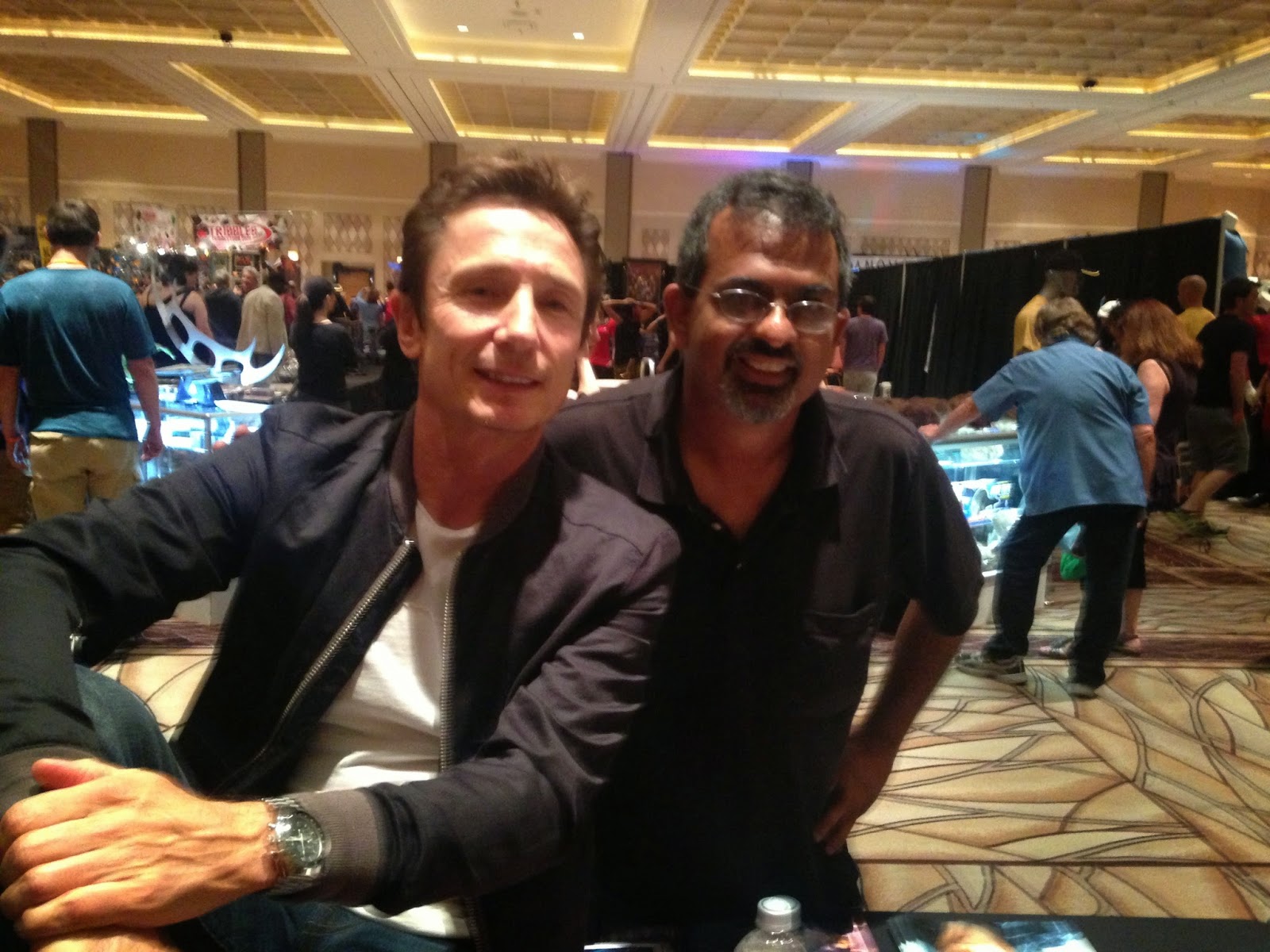
Any actor from any episode of the series is a minor “hero” at the Star Trek con. It was fun seeing them, and even a little sad. Speaking of Enterprise, see some of the images of me with actors from the show below – Connor Tinnear who played Trip, the lead Engineer, Anthony Montgomery, who played Travis, the helmsman, and Dominic Keating, who played Malcolm Reed, the chief tactical officer. The three of them were sitting at tables right next to each other, and there was a panel about Enterprise.
Even for someone like me, who has been involved in independent films, it was fun to be able to go up to people whose faces you’ve been seeing in your living room and actually talk to them. I even spent a few minutes talking to Richard Hatch, famous from the Battlestar Galactica series (the original series, and the more recent one). What does he have to do with Star Trek? He’s in a fan film. More on these later.
There was the guy who played Mark Twain on a classic Next Generation episode, and a panel with guys who had recurring roles on Deep Space Nine, Voyager, and even people who had only appeared in one or two episodes. You could talk to them, get their autographs and pics (for a fee – more on this later).
Someone remarked that it was a little sad that actors that had become so well known were reduced to “hawking pics and autographs” for money at the convention. It was a little sad to see that so many of the actors we loved didn’t seem to have as much on-going success or were in between series, making $20 to $75 per pic as one of their sources of income. But, on the other hand, they got to bask in the adulation of fans of their series, something which every actor probably aspires to and few achieve. That must be fun for them too.


A lot of women like Star Trek. A lot of couples too. And kids. 
When I was growing up, the really big Star Trek fans that I knew were mostly geeks, and mostly males. Maybe this is why I expected the convention to be kind of like my old engineering school – 70+% male. 
But it wasn’t. In fact, I’d say the con was split pretty evenly between male and female. And the girls were hot. Or maybe it was just the sixties version of future outfits (short dresses) on Saturday, cosplay day, which game me this impression. OK maybe not Vegas club hot – OK maybe I just have a thing for smart, geeky girls who like to dress up LOL. But there definitely were plenty of interesting costumes to see and admire. The Klingons and a Cardassians were among the best costumes I saw.
A lot of couples were there too, and these were split half and half between those who were both big star trek fans, and those where one was a big fan and those who dragged the other along to “see what it was like” at their first con. Many of them had matching Star Trek costumes – which was cute. Many of them brought their kids, and it was eye-opening to some of us older fans to realize that a whole new generation of fans existed, even though a real Star Trek series hasn’t been on the air in 10 years!


The Captains were the big thing, especially Shatner. While any actor from the series was a hero, the big draws were definitely the “captains”. William Shatner was there and drew the biggest crowd. I wondered how he would be with this crowd. There was a famous parody on Saturday Night Live of him making fun of Trekkies and telling them at a con to “Get a Life!”.
He certainly didn’t do that, but he was equal parts self-deprecatory, self-congratulatory, and serious. He handled the crowd well, and they seemed to hang on his every word. He made fun of himself and the fans, but in humorous ways that the crowd laughing even when the most embarrassingly adulatory questions were asked such as: “I want you to know that Captain Kirk was my hero and taught me how to be a man, and I aspired to be like him,” Even though he seemed a bit absorbed he went on about some story about breeding horses (he had recently hurt his foot). One fan asked him about Ricardo Montalban, who played Khan, and he had nothing but great things to say about him and Shatner told us how he felt when Ricardo passed away, which made Kirk seem to be a sensitive guy too!
Two other captains made it, Scott Bakula (Captain Archer from Enterprise), and Kate Mulgrew (Captain Janeway from Voyager), and, though they weren’t nearly as big as Shatner, I got a personal kick out of seeing them – and of course I had to stand in line to get a picture with them!


Be Prepared to Bring Your Checkbook. 
Star Trek conventions aren’t cheap. Actually, it is pretty cheap to get in with “Basic Admission” ($40 a day or so), but a good number of the repeat attendees had “Gold” passes and “Captain’s Chair” passes. These cost many hundreds of dollars. On top of that, every single autograph costs money. For example, I wanted to get two autographs from Scott Bakula, one for me and one for a friend, and had to pay $75 for each one. Plus every single picture that they are autographic costs money. Oh, and you want a pic with an actor, well be ready to shell out at least $20 for that (and over $100 for the more pouplar ones). 
I met some couples who spent many thousands of dollars just on the Star Trek con getting artifacts, not to mention travel and lodging in Vegas. Of course, you don’t have to spend money on these “extras”, but the convention is much less fun if you do. For me, this wasn’t a turn off by itself, but I could see how it might be for some folks, especially if you thought you can just show up and mingle with your favorite actors.

Star Trek fan films are all the Rage. 
An interesting recent phenomenon is that fans have started to make Star Trek fan-films and mini-series and post them onto the web. For the most part, these are done without permission from Paramount, and are often funded via kickstarter. The interesting thing is that they star real Star Trek actors, which makes them 
I hadn’t even been aware of these films nor had I taken them seriously. I met with Tim Russ, who played Tuvok on Star Trek Voyager (and whom I had met years ago at, of all things, a SETI convention), and he’s directed two fan films, including Star Trek: Of Gods and Men, and the upcoming Star Trek: Renegades, each of which have many Star Trek actors in there. I also met Richard Hatch, who stars as a Klingon in the upcoming fan film, Star Trek: Axonar. There was also buzz about Star Trek: Continuum which was said to be among the best ,and I met a group that shoots episodes of a fan series in the Star Trek universe in Atlanta each month.
There are of course the big JJ Abrams Star Trek films to keep the franchise alive, but in the absence of a true series, even though these are unauthorized and Paramount/CBS will most likely be clamping down on them, there does seem to be a lot of creativity in this arena! 


Star Trek, the Music, and the Wonder. 
Anyone who’s been to one of these conventions will tell you that they’re a bit overwhelming, with so may different things going on. There was one event that actually stood out – and I almost didn’t go. I decided to go at the last minute – it was a concert of Star Trek music. The Nevada pops orchestra was on stage one evening, and it turns out their conductor was a very big fan of Star Trek, and to prove it — he told all kinds of insider Star Trek jokes and lines that he and his wife quote regularly. 
I gotta say, this event stood out because when they played music from the various pictures, from Star Trek: The Motion Picture from 1979, or The Wrath of Khan from the early 80’s, or Star Trek: The Next Generation, or Voyager, it took me right back to those times in my life. 
I felt like a kid again, watching the TV with wonder in my eyes, and that excitement that maybe, maybe someday, I too would get to go the stars! 

For now, the next Star Trek Con will have to do!

Labels: , , , , , , , , , , ,


Read more!

Sunday, August 22, 2010

Aliens, Radio Signals, Warp Drive, and Dead Heads: SETI con asks "Are we alone?"

Anyone who’s been reading my blog will know that I’m a big fan of science fiction, and maybe even that I’m a big fan of scientific discovery, which is why I was excited to attend the first ever SETIcon in Santa Clara last weekend.

Although I had read a lot about SETI in the past, my main knowledge of the guys running SETI came from watching the movie Contact, starring Jodie Foster and based on the novel by astronomer Carl Sagan (of “billions and billions” fame).


Those of you who’ve seen the movie will recall Jodie Foster’s radio astronomer character (“Ellie Arroway”) being very upset when the funding for her search for extraterrestrial signals was cut off. In a last ditch effort, after being turned down for funding from everywhere including Hollywood (“Those guys have been making money from aliens forever!”), she ended up getting funding from an eccentric billionaire.

Whether art was imitating life or the other way around, SETI itself used to receive funding from NASA, but this was cut off in the 1990’s. Since then, Microsoft co-founder Paul Allen (yes, whom some would call an eccentric billionaire) donated quite a bit of money to set up the Allen Radio Telescope array so that the search for ET could go on utilizing private funding.

For those of you who don’t know, SETI basically studies radio (and now light) signals from various stars in the night sky, looking for evidence of an “intelligent” signal that could only come from an “intelligent” species that at the very least has mastered radio technology. SETI stands for Search for Extraterrestrial Intelligence, and has been going on in some form or another for almost 50 years.

To date, no confirmed signal has been found, though there have been several “candidate” signals that could never be re-acquired for further study.

The SETI institute is located in Mountain View, CA, which is just down the road from where I live (another benefit of being in Silicon Valley), and I was glad to be able to attend this conference so easily (it was held in Santa Clara). There were attendees from as far away as India and Kuwait, and as close as well, Santa Clara.


A Blending of Science, Science Fiction, and the Grateful Dead??

Since science fiction (in all of its forms) has always been a great way to get the public excited about science (everything from the Alien Attack movies in the 50's to Star Trek in the 60's forward), I was glad to see that this conference was not just about Radio astronomy (which I'm sure is a fascinating subject in and of itself), but included an intelligent blending of scientists and sci-fictionists (for lack of a better term). In my opinion not only did this make the conference more fun, but it also helped to open up our imaginations a bit, something that is necessary because the whole idea of extra-terrestrial intelligence is still speculation.

Despite being the first year of SETIcon, and a relatively small number of attendees, there were some great speakers – all of whom were pretty easy to approach and get to know. Here's a small sampling of SETIcon:


  • Mickey Hart - On Friday night, we were treated to seeing a preview of work from Mickey Hart – yes, that Mickey Hart, the drummer of the Grateful Dead , about the “rhythms of the universe”. It turns out he’s been collaborating with the scientists at the SETI institute working on a “sounds of the universe” DVD/CD. Mickey said he loves “timelines” and he always begins his books with a timeline that starts with “The Big Bang” from 13 billion years ago.
    For years, he’s wondered what this most primordial event of the universe (the Big Bang) might sound like. This DVD showed his on-going attempt to capture the sounds of the universe ("Everything is vibrating, so everything has a sound" - Mickey), and mix them with incredible visual images to make "art". Mickey pointed out that the Hindus and others speak of an original sound and the Greeks refer to the music of the spheres, so this isn't a new undertaking.
    Listening to this was almost like having a mystical experience, and added a bit of needed "right brain" creativity to what has been mostly a "left-brained" search for ET, and as a fan of the mystical, I enjoyed Mickey's presentation quite a bit. There were some deadheads in the audience, and you can bet they were more than a little excited to meet Mickey!

  • Dr. Frank Drake – anyone whose investigated the scientific possibility of for Extra Terrestrial intelligence will know of Frank Drake, who started investigating whether radio signals could be coming from intelligent alien signals some 50 years ago, dubbed Project Ozma. Frank Drake is considered the Father of modern day SETI, and he is the creator the of the well known Drake Equation, which is an equation that tries to estimate the number of intelligent civilizations there may be in our galaxy. Anyone who’s looked up at the night sky, marveling at the number of stars and wondering how there couldn’t be any life out there amongst the billions of points of lights will intuitively understand the Drake equation. Wikipedia even has a section on it: click here .
    Basically if you plug in some assumptions about the number of earth like planets orbiting earth like stars, and how many of these might have life on them, and how many of those are intelligent, and how long those intelligent civilizations might last, you end up wtih an estimate of how many intelligent civilizations we might communicate with our galaxy.

    Of course the big thing that's open about the Drake Equation are the actual factors - which make the resulting number vary widely. Carl Sagan estimated the number to close to 1 million, while Frank Drake himself estimates closer to 10,000. No matter how you slice it though, it's very difficult to make the number come out to "1", which makes it unlikely we are alone! On Saturday night at the conference, we had a banquet honoring Frank’s 80th birthday and 50th anniversary of Project Ozma, which was a fitting way to start the first SETIcon.

  • Dr. Jill Tartar. Jill is the director of SETI research at the SETI institute, and has a host of honors and recognition as a scientist and educator. Many say she was the inspiration for Jodie Foster’s character in the movie Contact, including being the point person for “pitching” for SETI funding after NASA discontinued it’s funding.

  • Tim Russ and John Billingsley Star Trek fans will recognize these names. Tim Russ played the Vulcan Tuvok on the Star Trek: Voyager series, and John played Dr. Flox in Star Trek: Enterprise series. Tim is an amateur astronomer and really committed to both astronomy and the SETI cause, and it was great to hear him on several panels. Although I couldn’t go to all the sessions, I think that he played out one of the most thought-provoking scenarios about interstellar travel (More on this later).


Of course there were many other speakers, including Robert J. Sawyer, an award winning science fiction author (who was the author of the novel that the TV series Flash Forward was based on), Andre Bormanis (who was the science advisor for several Star Trek series), Seth Shostak, SETI’s senior astronomer, who also does their podcast “Are we alone?” each week, Kevin Grazier (science adviser for Battlestar Galactica, who finally answered the question, How does Galactica’s FTL engines work?), Robyn Asmiov (Isaac Asimov’s daughter), and many real scientists - astronomers, astrophysicists and astro-biologists.

The speakers included, on a more personal note, an old mentor of mine from MIT, Greg Papodopolous, who left MIT many years ago to become the Chief Techonology Officer at Sun Microsystems. I did a research project with Greg on parallel computing during my undergrad days at MIT, and it was great fun to see him again and learn that he'd been involved with SETI also.

So, Did we Answer the Question? Are We Alone?

OK , so by now you’ve probably guessed that attending this conference was fun (it definitely was!), and from the speaker list, you probably guessed that I got to mix with a lot of interesting personalities (I did, and am still in touch with some of them!).

But, did I learn anything? More importantly, did it answer the burning question: Are we alone?

Yes and No.

Yes I did learn something, and no it didn’t answer the question of whether we are alone or not (you’d probably have heard about it on CNN if the conference had gone that far!)

But the conference raised a number of related questions which are equally as interesting, and easier to discuss, which the panelists did enthusiastically. On this front, I think mixing science fiction authors and actors with professors and PhD’s was a very smart move, since these questions have no simple answers, and are still to a large part, a matter of speculation.

Here they are, in my humble opinion, five of the most interesting questions raised at SETICON 2010 (other than “Are we alone”, of course), in no particular order:

  1. Should we be sending out signals to extra terrestrial societies? If so, what should we send? And Who speaks for the Earth?
    • This question came up again and again. Of course, SETI’s official charter is to look for signals, not to broadcast them. But there have been many broadcasts from Earth (including our TV signals starting from the 1940’s and 1950’s, as well as broadcast by Frank Drake from Arecibo, the big radio telescope in Peurto Rico).

      As eminent a scientist as Stephen Hawking has suggested that if we broadcast a signal, it could be picked up by a much more advanced civilization than ourselves, and …well you might see something like Independence Day (remember that movie with Will Smith)?
      Actually, joking aside, this a pretty serious concern, as many speakers pointed out that a less technologically advanced civilization has rarely withstood contact with a more technologically advanced civilization (case in point: the Native American population after contact with Europeans). Given my interest in both science fiction and native american history, I find this topic more than a little fascinating … I actually started writing a novel once about what might happen if a more technologically advanced alien civilization arrived here on Earth -it's called Synchronized - and this conference has led me to believe it's worth completing.


  2. Will we ever develop warp drive and be able to travel to the stars?
    • The scientists discussed this at length along with the science fiction authors and consultants to TV shows like Battlestar Galactica and Star Trek. From the point of view of the scientists, this would require traveling faster than the speed of light, something that is not permitted by Einstein’s theories of relatively. Lots of interesting ideas were discussed for “folding space” which wouldn’t violate Einstein's general theory of relativity, but the answer was that it would take so much energy to do this as to be practically impossible. When many members of the audience objected, the scientist pointed out that they weren't saying this to be negative. In fact, most scientists would love to figure out a way to get around Einstein's laws (they'd land a nobel prize if they could), but as far as we know, travelling to the stars at faster than light speeds would violate the known laws of physics.

      I actually thought the best answer to this question came from Tim Russ, of Star Trek: Voyager fame, and the only member of the panel who had actually flown faster than light (at least in a TV series). He said to imagine that we were sitting at a similar symposium at the time of Columbus, and the question we were being asked wasn’t about traveling over the water to the other side of the earth, but of traveling to the moon. Using the technology of the time, wind power and sails, it would seem “impossible” to ever get to the moon, even if all of the wind power on earth was utilized in the effort. So Tim was suggesting that there may be some kind of breakthrough that we don’t know about yet, which will let us travel to the stars – his bet was that it might have something to do with quantum mechanics and parllel realities. The scientists bet was that it wouldn't happen.

      I agree whole-headertedly with Tim that most scientists of today, just like the scientists of every other era, are a bit short-sighted and only looking at a limited perception of reality - that which has been proven in the past. I'm reminded of the head of the US patent office who resigned in the early 1900's because "everything that could ever be invented had already been invented"! Boy, was he wrong! Someday, there will probably be some unexpected new discovery or breakthrough that may make it possible to travel to the stars.


  3. If Aliens exist, where are they, why aren’t they here?
    • On an not-unrelated note, there was the more serious issue that if travel across stars will ever be possible, then we should assume some technologically advanced races (say a million years more advanced than we are) would have mastered that technology already. So, why haven't they visited us?

      This is a pretty controversial topic, because it relates to UFO theories and sightings, which pretty much every speaker on the panel dismissed as "lacking credibility".

      The only answer that made sense to me was that Earth is in a relatively uninteresting corner of the galaxy, and given the millions of likely planets out there, it’s unlikely that an intelligent species would visit here without some concrete reason to (other than to abduct us and do experiments on us). Since we've only mastered radio signals in the last 100 years, this means that any star that is more than 100 light years away wouldn’t have received any transmission from us, making Earth an unlikely place that someone from another part of the galaxy would want to visit. This seemed logical answer.


  4. Is Radio Astronomy the right way to look for Alien civilizations? How will we communicate with an alien civilization?

    • We are taking our current technology (radio signals) and using that as the basis under which a more advanced civilization might be broadcasting to us. This of course, gets at two core questions – will aliens communicate like we do, and is SETI looking in the right place?

      In my personal opinion, this is an interesting question and there’s no good way to answer it, and it probably deserves a much more investigation than was done at the conference. The best answer, given by senior Astronomer Seth Shostak, was that this is the best we can do right now, and any advanced civilization might realize that less advanced civilizations “come of age” when they master radio technology or wireless communication. Just as columbus didn't wait for better ships to be built, we can't wait for better radio telescopes to start our quest.


  5. Is SETI a worthwhile endeavor, should we continue to fund it?
    • Underlying many of the other questions, this was the pink elephant in the room. If it's such a difficult task to scan the whole night sky, and aliens might not even be communicating in ways we understand, is SETI worthwhile to do? Well, actually, as I mentioned, the government is no longer funding SETI proper (i.e. the search for radio signals, though NASA does fund astrobiology research at the SETI institute).

      100% of funding for SETI proper comes from private donations and tickets for events like SETI con. Personally, I think SETI has the ability to light up the imagination of the young, to make them more interested in math and science in a way that few other “official activities of our day” do. Whether an alien signal is found or not, it makes sense to have a program like SETI. Of course, if an alien signal IS FOUND, then this would probably be the biggest discovery in the history of the human race ... so I think i can speak for everyone at the conference who thought that we should all help fund SETI to a certain extent, since it concerns us all - not a single state or profession or nation. So, let's all chip in - at the very least if you're interested in the answer to these questions, be sure to attend SETICON 2011!


As you can see, answering each of these questions is not simple; I think I could easily write a separate blog post (or even a chapter in a book) on each of these questions. The panelists (and attendees!) brought up many thought-provoking points and counter-points on each of these and many other topics. (see www.seticon.com ) to see the full program.

In short, I think the conference was not only fun, it was also worthwhile. These kinds of questions force us to think of ourselves as a common species on a common planet, and not as individual fiefdoms known as countries or religions, which is why it’s very important to have something like SETI.

In the meantime, while SETI continues to search the heavens, it was pointed out again and again at the conference that that our TV broadcasts have been in space for more than 50 years already, which means that someone out there (within 50 light years) may have detected our presence already.

Which means that even if there were no signals directed at us in the past, there may very well be something – a signal or who knows what - coming our way in the future… all we have to do is keep our eyes (and ears and telescopes) aimed at the sky!

Labels: , , , , , , , , ,


Read more!

Tuesday, December 16, 2008

The Day the Earth Was Almost Destroyed

[NOTE: Now that I’m on winter break, I’m taking a partial hiatus from writing Stanford GSB related blog entries, at least until the term starts back up in January]

As a fan of Science Fiction movies, I couldn’t resist going to see “The Day the Earth Stood Still” – the new version with Keanu Reeves, on opening weekend. I’m a big fan of the old version from the 50’s, despite its dated cold war themes, and generally can’t stay away from anything Sci Fi related.

So what did I think of the new movie? I’d love to give it an enthusiastic thumbs up, but can only manage a “so-so” review.


The old and new films are both about the arrival of an alien visitor (who looks human, to make us comfortable, and whose name is Klaatu) who lands in a major American city (Central Park in the new one, and if I’m not mistaken Washington, DC in the old one). One thing that hasn’t changed from the old Cold War theme: The government tries to take possession of the alien, and shoots him. They won’t even consider allowing him to speak to a gathering of World leaders at the UN.

Are we really that parochial? If an alien really visited the Earth and landed in the US, is this the attitude that we would take?

Unfortunately, I think they got this one right, in both versions. I’d like to think that if the representative of an advanced civilization were to arrive to deliver a message to the Earth, just happens to land in the USA, that we would let him speak to the UN – to all the nations of this planet. But I can just see our military whisking away the alien away to Guantanamo as a presumed “enemy combatant” and commandeering his ship as “foreign technology” that we want to re-engineer.

A neat new twist in the movie is the reason for the alien’s visit. In this version, Klaatu is not just the representative of alien civilizations watching the Earth; he says he is a friend of the Earth (though as we learn, this doesn’t mean he’s necessarily a friend of the human race).

He’s here to decide whether we are killing the planet or not. This green theme is a pretty good new spin, if somewhat overused these days. Klaatu tells us that there are only a few habitable planets out there, and he can’t allow us (humans) to kill this one. Quoting Klaatu (Keanu Reeves): If the earth dies, humans die too. If only the humans die, then the earth still lives on. A fair, logical argument.

Like most good science fiction, the first part of this movie actually makes you think about larger issues. It certainly made me think about habitable planets and how many there might be out there. There’s a famous equation, the Drake equation if memory serves, that takes assumptions of the number of stars, the number of planetary systems, the number of habitable planets, and the number of advanced civilizations. If you work out the numbers with only 1% for each variable, you come up with a large number of inhabited worlds.

What would happen if the probabilities were so small that there only a few habited planets out there, as is the case in this movie?

And of course, this movie does make you think about what would really happen if an alien spacecraft were to visit our planet and why.

Those are the positives. Jennifer Connolly does a pretty good job as an astro-biologist (is there such a thing? How much biological material have we actually found in outer space?). She’s also the step-mother of 11-year old Jacob, whose army engineer father she married a few years ago, but who passed away.


This is where, in my opinion, the movie starts to fall apart. Why does this have to be the case with almost all science fiction movies?

They start with an interesting concept that actually makes you think; but, as they try to bring the movie into the standard hollywood three-act script, they all end up with some variation of the standard formulas, ruining the originality of the film and making the second half into a dumb thriller or action or preachy lesson.

I don’t think I’m revealing much when I say that that at first Klaatu decides to destroy humans off the face of the earth, because he views us as a destructive force (which the government cronies and the Secretary of Defense, played excellently by Kathy Bates, do a very good job of convincing Klaatu of).

Eventually, he comes to realize that humans are more than just a destructive force. That we have strong emotions and that they include compassion and longing, etc. This in-and-of-itself is not a problem - The problem is how he comes to this realization; It’s done through the 11-year old Jacob, who single-handedly destroys this multi-million dollar Hollywood production. Well done, kid. At least you saved the Earth, sort of.

So, OK, I have to admit, as a kid, I loved it when kids played an important role in science fiction. E.T. involved kids and aliens. Wesley Crusher had an interesting role in Star Trek the Next Generation.

But this one just doesn’t work. The 11-year old snot-nosed kid, not only disobeys his mother every chance he gets, sporting an “oh I’m so cool” braided hairstyle that’s well beyond his years, but he also tells the government exactly how and where to find Klaatu, leading to the abduction of his step-mom by the government in the process. We're then led to believe that this might have been a good thing becuase he got to spend more time with the Alien.

I have to say I wanted to smack the kid off the screen so that we could get on with a real science fiction movie. Alas, it was not to be.

After seeing the movie, I looked up some reviews to see if I was alone in this sentiment and was just being a cruel, heartless adult. Here’s my favorite part of the CNN review: “Jacob is a whiny, obstinate, and disobedient little boy that would lead most extraterrestrials – and not a few of the rest of us – to reach for the destruct button.” Amen.

For other science fiction fans out there, think Jar Jar Binks. Now I wish someone would get a-hold of this flim and create a phantom edit (for those of you who don’t know someone created an edit of Star Wars: The Phantom Menace which digitally editout out Jar Jar Binks, without whose annoying antics the film might have been a relatively good film). Unfortunately you’d have to chop off the whole third act of the movie to do this. Oops.

Note: As a film-maker myself, I’m not supposed to be suggesting that anyone do anything that infringes on the copyright of Hollywood films, so I can’t really condone a phantom edit. (BUT IF YOU HAVE ONE, LET ME KNOW, I’D BE HAPPY NOT ONLY TO WATCH IT BUT TO WRITE ABOUT IT HERE IN MY BLOG. EVEN BETTER: what if someone were to edit out the kid and put in Jar Jar Binks, the movie might be actually be more fun and less annoying!).

Labels: , , , , , , , , , , ,


Read more!